Showing posts with label insects. Show all posts

Sunday, August 02, 2026

Chatty AI

Recently, when I searched for a perennial that would do well with no morning sun or afternoon sun but about four hours of midday sun, yarrow was recommended. Then the search engine on my phone asked questions about my search results, which is something new to me. "We" chatted a bit over that before I bailed. (You don't have to politely end a "conversation" with AI - just rudely leave. So satisfying.)

My SO commented that his yarrow looks great but hasn't bloomed in years. So the next day I queried about that. The response was yarrow needs 6-8 hours of sun a day. I countered "But yesterday you said...." That elicited an apology and a clarification. Funny stuff.

Rudbeckia with a bit of ironweed

One thing AI seems inadequate for is identifying odd bugs. I haven't had any luck ID'ing these two. They both are very tiny.


However, common whitetail skimmers popped up after a text search, which is good because I can't get close enough for a photo. They seem to like the nodding onion.

Two adult mourning doves with their youngsters

My SO and I visited Fort Wayne Rocks, as I have a plan to create gravel paths through the larger beds so I can get into them, but I want to edge the paths with rocks to contain the gravel. I didn't order the rocks yet - need to clear out some yard waste first - but the price for a pallet of what I want is reasonable.

I mentioned my plan to my daughter and she flashed me some photos of what she would like to do with rocks. We both have flat yards, so nothing dramatic can be accomplished, but my idea is plain vanilla compared to hers.

Monday, May 12, 2025

What's it good for? Northern sea oats

Once upon a time, ornamental grasses were a new thing, or at least they were new to me. I believe that is when I first purchased northern sea oats (although I could be wrong about that). At any rate, they became a problem - spreading everywhere - so I moved some to the south side of the house where they can run rampant and eliminated the rest (mostly - an errant one pops up here and there in the front beds).

While whacking back the tops of the northern sea oats during my "fall cleanup" this spring, I got to wondering just what they are good for. Are they useless beauties or do they serve a function in the landscape?

According to this Missouri Botanical Garden post, northern sea oats attract birds, but which ones? The Avian Report says sparrows, juncos, chickadees, goldfinches, and mourning doves.

This Morton Arboretum post doesn't identify any uses for this plant.

The plant's Wiki page claims it is a "larval host plant for the Northern Pearly-Eye, and its seeds are food for birds and mammals. It is also eaten by the caterpillars of the pepper and salt skipper, Bell's roadside skipper, and bronzed roadside skipper butterflies.".

The entry at the Grow Native! website echoes its use as a host plant for the above insects and food source for birds and small mammals.

I've never noticed any caterpillars on my plants, nor have I observed birds or small mammels eating the seeds, but then I haven't really looked. Maybe I should pay more attention. At any rate, I'll keep them for now.

I *did* happen to notice this Gem moth the other day, across from the northern sea oats, on what is probably a rudbeckia. Initially, I didn't think I would be able to identify it, but upon closer inspection, saw the "eyes" on its wings.


Spring chores continue. I attacked the suckers at the base of backyard trees (have yet to tackle those in the front yard), pruned back the viburnum that were overtaking the witch hazel, and planted annuals and perennials. The only online purchases that remain to find a home are the heucheras, as I need to remove a couple of the aromatic asters first.

Installing a butterfly bush was on my list of goals for this year, but I have since reconsidered. It turns out that they are invasive. :-( Never mind that I can't seem to keep one alive. There are so-called "sterile" cultivars out there, but even those can still produce some viable seeds, up to 2% of 40,000 seeds per seed head. So scratch that item.

For Mother's Day, my daughter and I went kayaking at Chain O' Lakes State Park. The weather was perfect, it wasn't crowded, the water was high enough through the channels between the kettle lakes, there were no bugs, just turtles sunning on logs. We finished the excursion with dessert at the Magic Wand in Churubusco - I highly recommend the cherry cobbler with ice cream.

Sunday, May 04, 2025

Creeping Charlie and his cousins

I complain a lot about the Creeping Charlie in my yard, but some plants I've been referring to as CC are actually something else.

Borrowed photo (can't recall from where)

Creeping Charlie (Glechoma hederacea), a member of the mint family, is known by several other names: Ground Ivy, Creeping Jenny, Field Balm, Alehoof, and more. While eschewed by most gardeners, it does have its uses: provides nectar to some pollinators in early spring, is edible, has medicinal uses, was used in place of hops when brewing beer, etc. Some no-mow lawns include it in their seed mix.

Last summer I let it run rampant on the south side of the house while trying to keep it out of the garden beds there (it may have allelopathic qualities that cause it to compete with other plants). I thought it might be a natural (if non-native and invasive) no-mow alternative to lawn, but it doesn't withstand light traffic very well, so that area is a bit muddy now. Elsewhere in the yard, it gets treated with a broadleaf herbicide. For more info, see this post.

Purple Deadnettle (Lamium purpureum) is also a member of the mint family. It may be known as Red Deadnettle or Purple Archangel. It too provides forage in early spring, is edible, and has medicinal uses (as described here). I have it in my yard, but being a winter annual, it dies when the weather gets hot and isn't that much of a problem, or where it does pop up, it is easy to pull.

Henbit (Lamium amplexicaule) is yet another mint relative that is very similar to Purple Deadnettle. I probably have this in my yard, but I have not noticed it or assumed it was Deadnettle. To read a comparison between Purple Deadnettle with Henbit, visit this site.

What *is* growing in my yard is Bleeding Heart. They seem particularly prolific this year. I love them, wish they hung around longer.


While I whine about the lack of bugs in my yard, this year I've noticed a lot of ants. These busy little critters were trying to drag something much larger than themselves into their nest.


We have been having a LOT of rain recently - everything is so *green*. The lawn has needed twice-weekly mowing, and I've already cleaned out the gutters twice as well. The chokeberry shrubs are blooming, so maybe they will produce fruit this year. The ragwort is in its yellow glory, the wild geranium and blue star are doing their thing, and the columbine is just starting to bloom.

On the edible front, the strawberry plants are taking root, the garlic poking up, and the rhubarb heading toward first harvest. Even a remnant of my asparagus patch is providing me with a few spears here and there, enough for an omelette now and then.

Sunday, April 06, 2025

Hail yeah!

We are having all kinds of whacky weather these days: hail, thunderstorms, lots and lots of rain. The rain garden is currently a water feature - very full. That end of the yard is rather soggy as well. I have plans to remedy the latter.


I have a mason bee nesting box that has never hosted a mason bee. But perhaps this paper wasp nest is fulfilling that job? If I keep an eye on it, maybe I will see what emerges from those plugged cells.


It's going to be a busy week here at Woodchuck Acres, starting with the installation of a new furnace and AC tomorrow. The joys of homeownership are overrated, in my opinion - eventually stuff wears out and needs to be replaced - but I do like having a yard to play in.

Saturday, January 13, 2024

Squash bugs

I have not grown anything from the squash family for years, but for some reason this winter squash beetles have invaded the house, one at a time. Unless it's the same beetle over and over again? I capture them and release them outside (except for the one that went down the garbage disposal), but then one shows up again. Now that we are heading for sub-freezing temperatures, maybe that will stop.

The snow I reported last week melted. Then we received some more, which also melted. But this bit of snow will stick around for a while, as things are going to be VERY cold for a while.


The wind reminds me of the winter of 1978, but without the avalanche of snow that formed drifts over six feet high. I was working at an "automated egg laying facility" at the time. Regardless of the weather, the chickens had to be cared for and the eggs processed. They sent manure trucks into town to pick us up, and we spent the night sleeping on the floor in the supervisor's house on the premises. The following winter promised to be nearly as bad, so I quit. There were more snowy winters after that, with resulting spring floods. We were living in the country by then; a creek that ran to the nearby river separated us from our neighbor. When her furnace went out, the repairman borrowed a canoe from us to reach her house. Fun times.

This weather has brought more bird activity in the backyard, including frustrated starlings who cannot get to the mealworms, thanks to the feeder design. There are plenty of other options for them, so no one is going to starve on my watch.

Monday, October 09, 2023

Cool and rainy, just how autumn should be

I won't let anyone complain about the cooler temps or wet weather, since it is a vast improvement over the dry 80-degree days that immediately preceeded this change. I still have a tendency to overdress, but I have started to change over the bedding from summer mode to winter mode - first the fleece blanket, next the flannel sheets, then the wool duvet. Aaah!

Speaking of autumn changes, the red, white, and blue flamingos have given way to the Halloween ones. I wish these glowed in the dark. Maybe I can paint them with some luminescent acrylic? My son and his girl friend are on the lookout for some winter flamingos. Otherwise, the yard will be sans flamingos until spring.


This sad bean is the total harvest from my experiment of growing bush beans in a container. One of my mistakes was not using a deep enough container. Another mistake was leaving the container where critters could reach it. I'm not sure if the culprit was a rabbit or a raccoon. Next year, I will do better. (My son's comment was, "Charlie Brown would be proud.")


This critter on my doorstep is a giant crane fly. I don't believe I've ever seen one in my yard before.


The carpet of sunflowers surprised me by blooming. I haven't noticed too many pollinators enjoying the late display. We are past our usual frost date, so I'm sure these are destined for an early death.


The goldenrod is at its peak. If you look closely, you will notice the plant tags in front of and between each goldenrod plant. Those are where the new aster plants are. May they and the goldenrod co-exist in peace.


While I hope my tulip tree survives the winter, I have a plan B in place: two red maple trees to take its place. I might even plant a third one on the other side of the yard. As far as I am concerned, one can never have too many trees. Yes, they drop their leaves in the fall. But look who benefits! (I credit my leaf mulch for bringing back fireflies to my backyard.)

(I don't know the original source of this poster)

Usually, I mow around the trees, breaking up the leaves but leaving them to nourish the trees. Or else the mower blows them onto the mulched beds. Either way, they decompose naturally.

Speaking of mulched beds, one of my dogs has taken to digging in the mulch and eating something - grubs? cicada larvae? I wanted to cover the mulch with bits of fencing (poultry wire and hardware cloth) to deter him, but I couldn't find much. Then I remembered that it was already in use as a dog-deterrent - it makes up a haphazard fence around the rain garden while those plants get established. Apparently, when one has dogs, one never has enough fencing.

Saturday, May 27, 2023

Tale of two trees

I'm worried about my tulip tree. It is not leafing out like it should by now. It's location is near where the pagoda dogwood died, but it's root structure is supposed to be similar in size and shape as its above ground growth. It's been here since 2009, so one would think it would be permanently established by now. I've had other trees with bad years that later recovered, but I am beginning to lose hope on this one. Maybe a tree expert can help?

Redbud branches on the left, tulip tree branches on the right

Meanwhile, the little hickory tree looks GREAT, very leafy. It has a tap root that hopefully can penetrate my awful clay soil, so I'm hoping it lives a long time. But then, I hope that for all my trees. And shrubs. And perennials.

The leaves look droopy, but it's fine

Most of the spring flowers are gone, but the early summer ones are taking their place. I whacked the honeysuckle vine several months ago, but it blooms on undaunted. It attracts hummingbirds and will bloom most of the season. The two new ones are still getting established.

Close up of honeysuckle vine blossoms

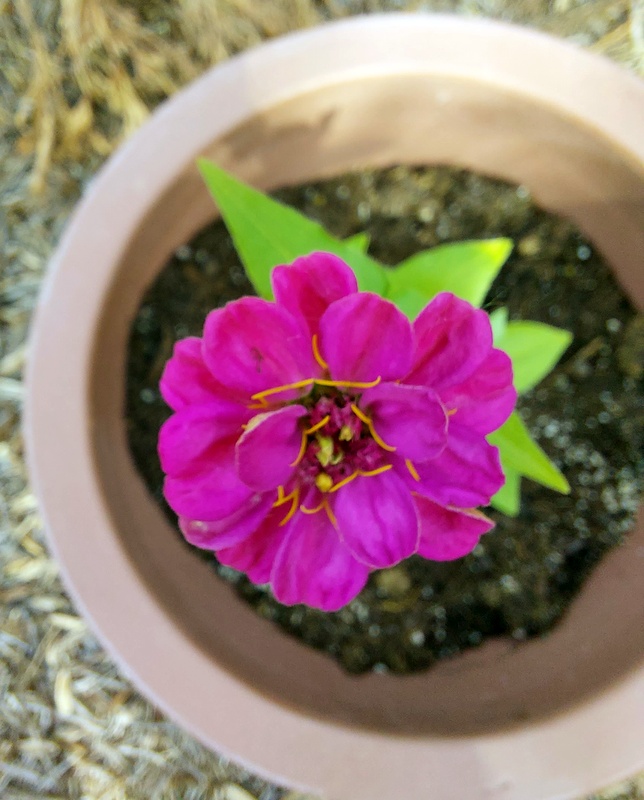
Even the zinnia transplants are getting into the game.

First zinnia bloom of the season

And, of course, there are bugs, although not too many yet. This week is starting out cool, but hot days are promised later on. And dry. I think we are having a (hopefully) mini drought.

It looks like a flying ant

I cut down the rest of the ragwort, so now I can address the weeds that are trying to get a foothold in those beds. The grass seed I planted on the north side of the yard (some of which got flooded, some of which got ignored for a while) is taking root. I've been hardening off the sweet potato vines and tomato plants, so will transplant them today.

Watson, a.k.a. Houdini, almost managed to crawl under the shed, presumably in pursuit of a rabbit. If he had gotten under there, I doubt he could have gotten out by himself, nor could I have been able to rescue him. Who does one call in such a situation? Animal Control? The fire department? I stacked some broken pavers at his access point, so hopefully I won't have to figure that problem out. Then I caught him eating potting soil from one of the zinnia pots. WTH?

My hummingbird feeder broke, so I purchased a simple one from Wild Birds Unlimited. Even though I saw one hummingbird several weeks ago, none have been by since. Ditto the oriole feeder and bluebird box. Plenty of starlings, though. :-(

I tried out the Ego trimmer. It does a fine job, and is very balanced, but it's a bit heavy; my left bicep cramped up after a while. At least, I don't have to wrestle with a long extension cord anymore.

And now I think I'll get to those tomato plants.

Saturday, October 15, 2022

It's alive!

I have this theory. Most houseplants are tropical in nature. They may like it warm and humid, but they don't necessarily like strong sunlight. My theory is based on the behavior of my dracaena plants. One grew so tall that it pushed against my 8-foot ceilings. I eventually just whacked off the entire top and rooted it. It's in the livingroom where it gets mostly indirect light. And, surprise, surprise, it did not grow big and tall, but just sits there like a nicely behaving houseplant should.

Meanwhile, the naked stalk just sat there, too. I began to think that since it had no greenery, it had died. I moved it next to the fireplace where it appears to keep Beau the Feline Destroyer of All Things Nice from climbing onto the mantel. Today, I noticed a leaf bud! So it is not dead. Hopefully, it won't shoot up to the ceiling again.


Recently, the NYTimes published an article by Margaret Roach about Charley Eiseman and leaf miners. Of course, I had to go out and check my plants for leaf miners. I didn't find any, but I found a few other bugs.


I should get a book on insect identification. I don't know exactly what these bugs are, but I did determine that the wasp on the oak gall is not the oak gall wasp. What this one is doing is a mystery. And he wasn't alone. I'll have to pay more attention to the littlest creatures in my backyard.


While watering (hopefully for the last time) the new plants out front, I noticed this monarch crawling along the ground. It acted as though it had newly emerged from a cocoon (which I was unable to locate). I helped it over to one of the aromatic asters, but it wasn't interested. Instead, it took shelter under a wild geranium. The next day it was gone. I wondered if it was from one of the caterpillars I spotted a few weeks ago. Could be. That would be a native gardener's success story.


I have a date for my next shoulder replacement surgery: November 30. Like an ant, I am preparing for the ordeal: cooking batches of soup for the freezer, deep housecleaning, accumulating some new jigsaw puzzles, etc. The yard will basically be done for the season then, so no worries there. And I'll have an excuse to not do anything or go anywhere for a while.